India’s Quality-First Generation
Fast Lives, Slow Purchases

1. The Death of the Impulse Buyer
Picture this: a 23-year-old in Bandra is scrolling Instagram at 2 a.m. Her thumb moves faster than a Mumbai local during rush hour—posts flash by in under a second, stories blur, a Reel plays at 1.5× speed. She sees a ₹4,999 dress.
She likes it.
She saves it.
She closes the app.
Three days later, after four Reddit threads and two WhatsApp group interrogations, she buys a ₹2,499 dress from a brand nobody over forty has heard of.
This isn’t hesitation.
It’s architecture.
The Millennial generation built lives on the shaky foundations of EMI culture and flash sales. Buy now, manage later was the unofficial motto.
Gen Z treats a ₹500 skincare purchase like a marriage proposal.
They are the fastest generation in history that refuses to spend fast. In the ₹1-lakh-crore opportunity that is Gen Z India, impulse didn’t disappear.
Trust replaced it.
2. The Quality Mandate: Insurance, Not Aspiration
Let’s bury a myth right now.
Gen Z isn’t premiumising.
They’re de-risking.
When they say quality, they aren’t looking for gold-plated packaging or celebrity endorsements. They want a guarantee against regret.
Will this last?
Will it disappoint me?
Will I regret this?
The data is unequivocal: 43% of urban Gen Z cite product quality as their top purchase driver—more than double the number who prioritise price (20%).
Quality isn’t a luxury.
Quality is insurance.
This is trauma-informed consumption. Having witnessed the volatility of the early 2020s—lockdowns, layoffs, speculative bubbles—things that last became the new flex.
3. The Social Media Filter (Not the Funnel)
This is where brands are bleeding money.
They think social media is a funnel.
For Gen Z, social media is a filter.
Visibility creates awareness.
Trust creates transactions.
The pattern is brutal: high discovery, low conversion. In Mumbai, 88% of Gen Z consumers rarely buy directly after seeing something on social media.
They don’t watch influencers for aspiration.
They watch them for verification.
Performance marketing fails here because it confuses attention with intent. You cannot retarget your way into someone’s trust.
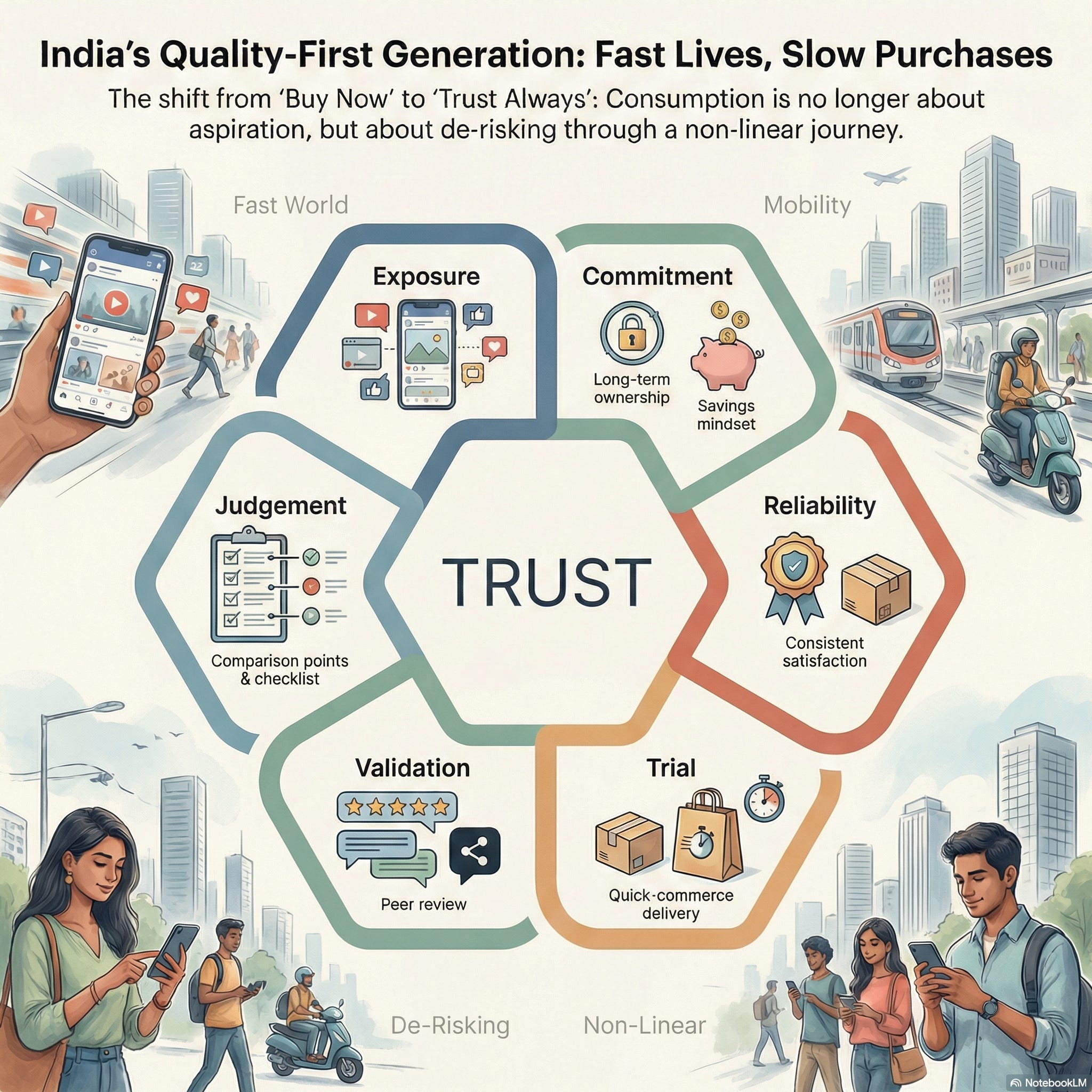
4. The Hankins Hexagon: Why Journeys Jump
The marketing funnel is a lie.
It implies a straight line.
Gen Z doesn’t move in lines.
They move in jumps.
The reality is the Hankins Hexagon—a non-linear loop where consumers move between exposure, judgement, validation, trial, trust, and commitment in no fixed order.
A student in Delhi discovers a brand online. She doesn’t buy. She checks a dark-social WhatsApp group. She visits a store to touch the fabric.
Every jump is a trust checkpoint.
Fail one, and the loop resets.
5. The Conservative Capitalists
Gen Z is better at managing money than the generations before them.
They aren’t frugal.
They are tactical.
Savings equal optionality: 41% save between 20% and 40% of their income. Among post-graduates, this rises to 52%.
Debt is a risk, not a tool: 62% avoid borrowing for lifestyle spending. They saw the EMI stress of Millennials and opted out.
Fixed deposits aren’t “boring” anymore—they’re predictable. And in 2026, predictability is the ultimate luxury.
6. Big Dreams, Slow Timelines
They haven’t rejected the Indian Dream.
They’ve redesigned the timeline.
More than half still aspire to own both a home and a car—but ownership is delayed in favour of mobility.
As income rises, flexibility matters more than possession. Renting isn’t a compromise; it’s mobility insurance.
They approach adulthood like a software update—
they’ll install it, but only after the bugs are worked out.
7. One Generation, Four India’s
If you think a 24-year-old in Mumbai behaves like a 24-year-old in Kolkata, the market is already lost.
Age explains intent.
Geography explains behaviour.
West (Mumbai / Pune): The Efficiency Capital
With 83% adoption of quick commerce, they pay for time. They switch brands less once trust is earned.East (Kolkata): The Discovery Capital
Consumption is identity exploration. High experimentation, low initial loyalty—but high upside for story-led brands.North (Delhi / NCR): The Asset-Aspiration Capital
Still the stronghold of the “Home + Car” dream, now filtered through durability and resale logic.South (Bengaluru / Chennai): The Value-Disciplined Capital
Lead adopters of digital gold and high-yield savings. Purchases are utility-first and long-horizon.
The Tier-II Paradox bridges these regions: Tier-II cities show stronger intent for exclusive premium consumption (16%) than metros (10%). Digital access erased the information gap, but culture rewrote how that information gets used.
8. The Reliability Reward
Brands keep making the same three mistakes:
pushing BNPL debt
over-relying on influencer reach
operating with a metro bias
Gen Z doesn’t reward excitement. They reward reliability.
The impulse buyer is dead. In their place stands a consumer who pauses—not because they lack desire, but because they finally understand the true cost of regret.
Data grounded in the BT-PRICE Gen Z Consumption Behaviour Survey (n = 4,311 urban respondents across 12 Indian cities, December 2025).